Several Gordon Families from Kirkcudbrightshire, Scotland
a family history project
Records, Notes, and Images – Person Page 27

Records, Notes, and Images – Person Page {0}
Rhoda Clara Rainsford-Hannay
#651, (1843 - 1887)
Parents
| Father | Major Frederick Rainsford-Hannay (1810 - 1884) |
| Mother | Rhoda Johnston ( - Bef 1872) |
Family: Reverend Sir James Cameron Lees (1834 - 1913)
| Daughter | Constance Lees (1874 - ) |
| Daughter | Mabel Lees (1876 - 1894) |
| Son | John Lees (1879 - ) |
| Son | John Cameron Lees (1879 - 1909) |
| Person included on these Charts: | Descendants of Odo A'Hannay of Sorbie |

- 1843
- 1851~830 Mar 1851Rhoda was enumerated as the son of Major Frederick Rainsford-Hannay on the 1851 Census of Scotland residing at Hill House in Kirkmabreck Parish, Kirkcudbrightshire, ScotlandG. She was ~8 years old.
Also residing in the same household were Rhoda Johnston, Mary Charlotte Rainsford-Hannay, Colonel Ramsay William Rainsford-Hannay, DL JP, and Jane S. Rainsford-Hannay.Citation: 2 - 1872~29Marriage | Reverend Sir James Cameron Lees7 Feb 1872Reverend Sir James Cameron Lees and she were married on 7 Feb 1872 at Kirkdale HouseG, in Kirkmabreck Parish, Kirkcudbrightshire, ScotlandG.Citation: 3
- 1881~383 Apr 1881Rhoda was enumerated as the wife of Reverend Sir James Cameron Lees on the 1881 Census of Scotland residing at 33 Blacket Place in Edinburgh, Midlothian, ScotlandG. She was ~38 years old.
Also residing in the same household were Constance Lees, Mabel Lees, and John Lees.Citation: 1 - 1887~44
- 1887~44
Citations
- [S19] General Registry Office of Scotland, online www.scotlandspeople.gov.uk, 1881 Scotland Census. Hereinafter cited as General Registry Office.
- [S20] Ancestry.com, online www.ancestry.com, 1851 Scotland Census. Hereinafter cited as Ancestry.com.
- [S19] General Registry Office, online www.scotlandspeople.gov.uk, Statutory Marriage Registrations.
- [S19] General Registry Office, online www.scotlandspeople.gov.uk, Statutory Death Registrations.
- [S21] Find A Grave, online www.findagrave.com, Find A Grave Memorial# 151291658. Hereinafter cited as Find A Grave.
Percival Rainsford-Hannay
#652, (1851 - 1941)
Parents
| Father | Major Frederick Rainsford-Hannay (1810 - 1884) |
| Mother | Rhoda Johnston ( - Bef 1872) |
| Person included on these Charts: | Descendants of Odo A'Hannay of Sorbie |

- 1851Birth1851Percival Rainsford-Hannay was born in 1851.
- 1901~5031 Mar 1901Percival was enumerated as the brother of Colonel Ramsay William Rainsford-Hannay, DL JP, on the 1901 Census of Ireland in Grange, Douglas, County Cork, IrelandG. He was ~50 years old.
Also residing in the same household were Helen Jane Brancker, Mary Rainsford-Hannay, and Rhoda Helen Rainsford-Hannay. - 1917~665 Feb 1917He was the Informant on the Death Registration of Helen Jane Brancker on 5 Feb 1917 in Kirkmabreck Parish, Kirkcudbrightshire, ScotlandG.Citation: 1
- 1941~90Death1941He died in 1941 at age ~90.
Citations
- [S19] General Registry Office of Scotland, online www.scotlandspeople.gov.uk, Statutory Death Registrations. Hereinafter cited as General Registry Office.
Brig-General Frederick Rainsford-Hannay
#653, (1854 - 1950)
Parents
| Father | Major Frederick Rainsford-Hannay (1810 - 1884) |
| Mother | Rhoda Johnston ( - Bef 1872) |
Family: Emily Louisa Wilkie
| Daughter | Marjorie Rainsford-Hannay (Abt 1895 - ) |
| Person included on these Charts: | Descendants of Odo A'Hannay of Sorbie |
- 1854
- 1887~33
- 1887334 Nov 1887He was the Informant on the Death Registration of Rhoda Clara Rainsford-Hannay on 4 Nov 1887 in Edinburgh, Midlothian, ScotlandG.Citation: 4
- 189136
- 1950~96Note1950He was educated at Royal Military Academy, Woolwich, Kent, England.
He gained the rank of Brigadier-General in the service of the Royal Engineers and was Commandant between 1907 and 1908 at School of Military Engineering, Roorkee, India.
He was invested as a Companion, Order of the Bath (C.B.) in 1911 and was Commandant between 1914 and 1917 at School of Military Engineering, Roorkee, India.
He was Director of Fortifications and Works, Army HQ.
He was invested as a Companion, Order of St. Michael and St. George (C.M.G.) in 1918.Citation: 1 - 195096
Citations
- [S22] ThePeerage.com website compiled by Darryl Lundy, Wellington, New Zealand, online www.thepeerage.com. Hereinafter cited as ThePeerage website.
- [S20] Ancestry.com, online www.ancestry.com, Scotland, Select Births and Baptisms, 1564-1950. Hereinafter cited as Ancestry.com.
- [S19] General Registry Office of Scotland, online www.scotlandspeople.gov.uk, Statutory Death Registrations (Rhoda Clara Lees, his sister). Hereinafter cited as General Registry Office.
- [S19] General Registry Office, online www.scotlandspeople.gov.uk, Statutory Death Registrations.
- [S24] FreeBMD website, online www.freebmd.org.uk, Kensington District, Vol 5c, Page 1122. Hereinafter cited as FreeBMD website.
Mary Charlotte Rainsford-Hannay
#654, (1842 - 1900)
Parents
| Father | Major Frederick Rainsford-Hannay (1810 - 1884) |
| Mother | Rhoda Johnston ( - Bef 1872) |
| Person included on these Charts: | Descendants of Odo A'Hannay of Sorbie |
- 1842
- 1851~930 Mar 1851Mary was enumerated as the daughter of Major Frederick Rainsford-Hannay on the 1851 Census of Scotland residing at Hill House in Kirkmabreck Parish, Kirkcudbrightshire, ScotlandG. She was ~9 years old.
Also residing in the same household were Rhoda Johnston, Rhoda Clara Rainsford-Hannay, Colonel Ramsay William Rainsford-Hannay, DL JP, and Jane S. Rainsford-Hannay.Citation: 1 - 1900~58
- 1900~58
- 1901Probate21 Jun 1901She had her estate probated on 21 Jun 1901. The Probate entry reads:
RAINSFORD-HANNAY Mary Charlotte of Howrah, Bengal, India, spinster died 16 November 1900 at Sehora Jahalpur, Central Provinces, India. Administration (with Will) (Limited) London 21 June to Ramsay William Rainsford Hannay colonel in the Royal Artillery the attorney of the reverend Edward Theodore Sandys clerk. Effects £2091 15s. 2d.
Citations
- [S20] Ancestry.com, online www.ancestry.com, 1851 Scotland Census. Hereinafter cited as Ancestry.com.
- [S20] Ancestry.com, online www.ancestry.com, England & Wales, National Probate Calendar (Index of Wills and Administrations), 1858-1966, 1973-1995.
- [S9] Alison Mitchell, compiler, The Stewartry of Kirkcudbright Monumental Inscriptions, Pre 1855 (Edinburgh, Scotland: Scottish Genealogy Society, 1995), Volume 6, Section 27b, Grave 2. Hereinafter cited as Kirkcudbright Monumental Inscriptions.
Helen Jane Brancker
#655, (1847 - 1917)
Parents
| Father | John Brancker (Abt 1819 - ) |
| Mother | Mary Reallo (Abt 1822 - ) |
Family: Colonel Ramsay William Rainsford-Hannay, DL JP (1844 - 1933)
| Daughter | Mary Rainsford-Hannay (1876 - 1938) |
| Son | Colonel Frederick Rainsford-Hannay, CMG DSO DL JP+ (1878 - 1959) |
| Son | Lieut Col. John Rainsford-Hannay+ (1879 - 1951) |
| Daughter | Rhoda Helen Rainsford-Hannay (1881 - 1941) |
| Son | Lieut. Col. Archibald Gordon Rainsford-Hannay (1882 - 1971) |
| Son | Major Ramsay Rainsford-Hannay (1884 - 1917) |
| Son | Lieut. Col. Donald Rainsford-Hannay (1885 - 1946) |
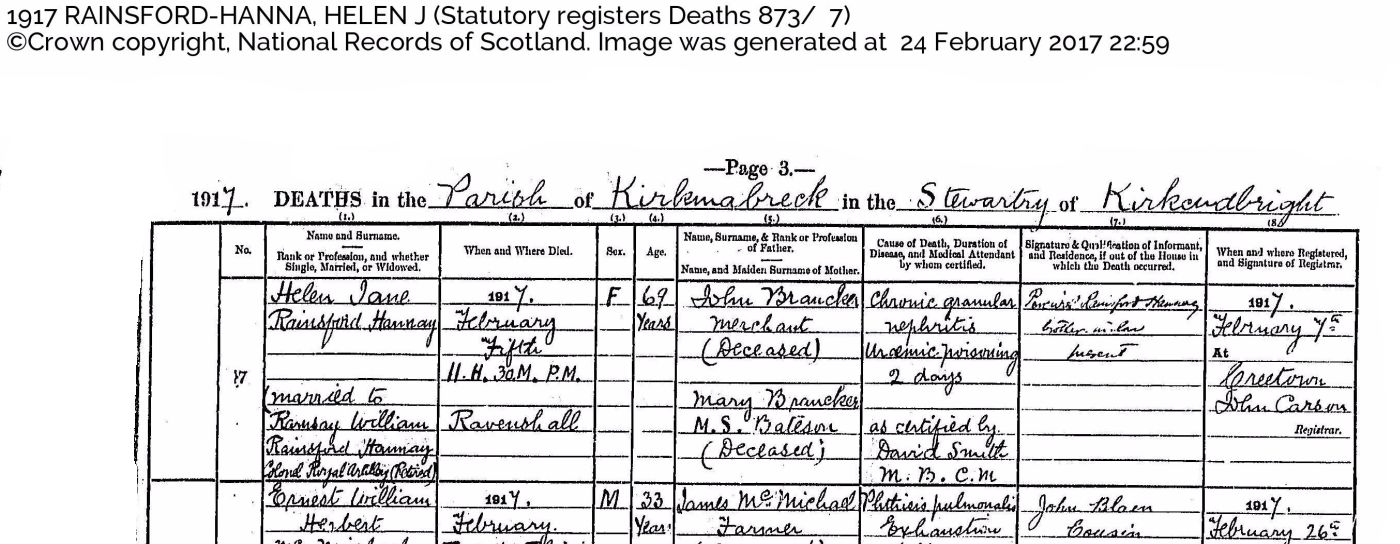
Helen Jane Brancker Rainsford-Hannay death 1917
- 1847
- 18470
- 18742730 Dec 1874Colonel Ramsay William Rainsford-Hannay, DL JP, and she were married on 30 Dec 1874 in Liverpool, West Derby District, Lancashire, EnglandG.
- 1881343 Apr 1881Helen was enumerated as the daughter of John Brancker on the 1881 Census of England residing at Greenbank House in Liverpool, Toxteth Park, Lancashire, EnglandG. She was 34 years old.
Also residing in the same household were Mary Reallo, Mary Rainsford-Hannay, Lieut Col. John Rainsford-Hannay, and Rhoda Helen Rainsford-Hannay.Citation: 1 - 1891445 Apr 1891Helen was enumerated as the wife of Colonel Ramsay William Rainsford-Hannay, DL JP, on the 1891 Census of England in Portsmouth, Portsea, Hampshire, EnglandG. She was 44 years old.
Also residing in the same household were Mary Rainsford-Hannay, Colonel Frederick Rainsford-Hannay, CMG DSO DL JP, Lieut Col. John Rainsford-Hannay, Rhoda Helen Rainsford-Hannay, Lieut. Col. Archibald Gordon Rainsford-Hannay, Major Ramsay Rainsford-Hannay, and Lieut. Col. Donald Rainsford-Hannay.Citation: 6 - 19015431 Mar 1901Helen was enumerated as the wife of Colonel Ramsay William Rainsford-Hannay, DL JP, on the 1901 Census of Ireland in Grange, Douglas, County Cork, IrelandG. She was 54 years old.
Also residing in the same household were Mary Rainsford-Hannay, Rhoda Helen Rainsford-Hannay, and Percival Rainsford-Hannay. - 191769
- 191769
Citations
- [S20] Ancestry.com, online www.ancestry.com, 1881 England Census. Hereinafter cited as Ancestry.com.
- [S20] Ancestry.com, online www.ancestry.com, Liverpool, England, Church of England Baptisms, 1813-1906.
- [S19] General Registry Office of Scotland, online www.scotlandspeople.gov.uk, Statutory Birth Registrations (Rhoda Helen Rainsford-Hannay, daughter). Hereinafter cited as General Registry Office.
- [S20] Ancestry.com, online www.ancestry.com, England & Wales, Civil Registration Birth Index, 1837-1915, West Derby District, Vol 8b, Page 666.
- [S24] FreeBMD website, online www.freebmd.org.uk, West Derby District, Vol 8b, Page 666. Hereinafter cited as FreeBMD website.
- [S20] Ancestry.com, online www.ancestry.com, 1891 England Census.
- [S19] General Registry Office, online www.scotlandspeople.gov.uk, Statutory Death Registrations.
- [S9] Alison Mitchell, compiler, The Stewartry of Kirkcudbright Monumental Inscriptions, Pre 1855 (Edinburgh, Scotland: Scottish Genealogy Society, 1995), Volume 6, Section 27b, Grave 2. Hereinafter cited as Kirkcudbright Monumental Inscriptions.
Mary Rainsford-Hannay
#656, (1876 - 1938)
Parents
| Father | Colonel Ramsay William Rainsford-Hannay, DL JP (1844 - 1933) |
| Mother | Helen Jane Brancker (1847 - 1917) |
| Person included on these Charts: | Descendants of Odo A'Hannay of Sorbie |
- 1876
- 18760
- 188143 Apr 1881Mary was enumerated as the granddaughter of John Brancker on the 1881 Census of England residing at Greenbank House in Liverpool, Toxteth Park, Lancashire, EnglandG. She was 4 years old.
Also residing in the same household were Mary Reallo, Helen Jane Brancker, Lieut Col. John Rainsford-Hannay, and Rhoda Helen Rainsford-Hannay.Citation: 2 - 1891145 Apr 1891Mary was enumerated as the daughter of Colonel Ramsay William Rainsford-Hannay, DL JP, on the 1891 Census of England in Portsmouth, Portsea, Hampshire, EnglandG. She was 14 years old.
Also residing in the same household were Helen Jane Brancker, Colonel Frederick Rainsford-Hannay, CMG DSO DL JP, Lieut Col. John Rainsford-Hannay, Rhoda Helen Rainsford-Hannay, Lieut. Col. Archibald Gordon Rainsford-Hannay, Major Ramsay Rainsford-Hannay, and Lieut. Col. Donald Rainsford-Hannay.Citation: 3 - 19012431 Mar 1901Mary was enumerated as the daughter of Colonel Ramsay William Rainsford-Hannay, DL JP, on the 1901 Census of Ireland in Grange, Douglas, County Cork, IrelandG. She was 24 years old.
Also residing in the same household were Helen Jane Brancker, Rhoda Helen Rainsford-Hannay, and Percival Rainsford-Hannay. - 1913~37
- 191336Marriage | Edward Adam Cliff-McCullough20 May 1913Edward Adam Cliff-McCullough and she were married on 20 May 1913 at Troqueer Church in Maxwelltown, Troqueer Parish, Kirkcudbrightshire, ScotlandG.
- 193862
Citations
- [S20] Ancestry.com, online www.ancestry.com, India, Select Births and Baptisms, 1786-1947. Hereinafter cited as Ancestry.com.
- [S20] Ancestry.com, online www.ancestry.com, 1881 England Census.
- [S20] Ancestry.com, online www.ancestry.com, 1891 England Census.
- [S19] General Registry Office of Scotland, online www.scotlandspeople.gov.uk, Statutory Marriage Registrations. Hereinafter cited as General Registry Office.
Colonel Frederick Rainsford-Hannay, CMG DSO DL JP
#657, (1878 - 1959)
Parents
| Father | Colonel Ramsay William Rainsford-Hannay, DL JP (1844 - 1933) |
| Mother | Helen Jane Brancker (1847 - 1917) |
Family: Dorothea Letitia Maxwell (1888 - 1981)
| Son | Ramsay William Rainsford-Hannay, 15th of Kirkdale+ (1911 - 2004) |
| Son | Gavin Rainsford-Hannay (1914 - 1914) |
| Person included on these Charts: | Descendants of Odo A'Hannay of Sorbie |
- 1878
- 18780
- 1891125 Apr 1891Frederick was enumerated as the son of Colonel Ramsay William Rainsford-Hannay, DL JP, on the 1891 Census of England in Portsmouth, Portsea, Hampshire, EnglandG. He was 12 years old.
Also residing in the same household were Helen Jane Brancker, Mary Rainsford-Hannay, Lieut Col. John Rainsford-Hannay, Rhoda Helen Rainsford-Hannay, Lieut. Col. Archibald Gordon Rainsford-Hannay, Major Ramsay Rainsford-Hannay, and Lieut. Col. Donald Rainsford-Hannay.Citation: 3 - 1910~32
- 191032Marriage | Dorothea Letitia Maxwell16 Aug 1910He and Dorothea Letitia Maxwell were married on 16 Aug 1910 at Anwoth Church in Anwoth Parish, Kirkcudbrightshire, ScotlandG.Citation: 4
- 193859Passenger List18 Mar 1938He was found on a passenger list on 18 Mar 1938 in Southampton, EnglandG. They sailed aboard the "Baloeran" with the destination of Tangier, Morocco.
- 19416322 Jun 1941He was the Informant on the Death Registration of Rhoda Helen Rainsford-Hannay on 22 Jun 1941 in Gatehouse of Fleet, Anwoth Parish, Kirkcudbrightshire, ScotlandG.Citation: 5
- 195475
- 195981
- 195981
- 1959Probate1 Dec 1959He had his estate probated on 1 Dec 1959. The Probate entry reads:
RAINSFORD-HANNAY Frederick, C.M.G., D.S.O. of Cardoness, Gatehouse of Fleet, died 11 September 1959. Confirmation of Norman Seth Pringle writer to the Signet Dorothea Letitia May Rainsford-Hannay and Ramsay William Rainsforth-Hannay barrister at law. Sealed London 1 December 1959.Citation: 7
Citations
- [S20] Ancestry.com, online www.ancestry.com, 1881 England Census. Hereinafter cited as Ancestry.com.
- [S20] Ancestry.com, online www.ancestry.com, India, Select Births and Baptisms, 1786-1947.
- [S20] Ancestry.com, online www.ancestry.com, 1891 England Census.
- [S19] General Registry Office of Scotland, online www.scotlandspeople.gov.uk, Statutory Marriage Registrations. Hereinafter cited as General Registry Office.
- [S19] General Registry Office, online www.scotlandspeople.gov.uk, Statutory Death Registrations.
- [S20] Ancestry.com, online www.ancestry.com, UK, Outward Passenger Lists, 1890-1960.
- [S20] Ancestry.com, online www.ancestry.com, England & Wales, National Probate Calendar (Index of Wills and Administrations), 1858-1966, 1973-1995.
- [S9] Alison Mitchell, compiler, The Stewartry of Kirkcudbright Monumental Inscriptions, Pre 1855 (Edinburgh, Scotland: Scottish Genealogy Society, 1995), Volume 6, Section 27b, Grave 8. Hereinafter cited as Kirkcudbright Monumental Inscriptions.
Lieut Col. John Rainsford-Hannay
#658, (1879 - 1951)
Parents
| Father | Colonel Ramsay William Rainsford-Hannay, DL JP (1844 - 1933) |
| Mother | Helen Jane Brancker (1847 - 1917) |
Family: Evelyn Gordon Forbes (1880 - 1950)
| Daughter | Marjorie Gordon Rainsford-Hannay (1907 - ) |
| Son | Patrick Ramsay Rainsford-Hannay+ (1911 - 1968) |
| Son | Denis Lewis Errington Rainsford-Hannay (1914 - 1928) |
| Person included on these Charts: | Descendants of Odo A'Hannay of Sorbie |
- 1879
- 188113 Apr 1881John was enumerated as the grandson of John Brancker on the 1881 Census of England residing at Greenbank House in Liverpool, Toxteth Park, Lancashire, EnglandG. He was 1 years old.
Also residing in the same household were Mary Reallo, Helen Jane Brancker, Mary Rainsford-Hannay, and Rhoda Helen Rainsford-Hannay.Citation: 3 - 1891115 Apr 1891John was enumerated as the son of Colonel Ramsay William Rainsford-Hannay, DL JP, on the 1891 Census of England in Portsmouth, Portsea, Hampshire, EnglandG. He was 11 years old.
Also residing in the same household were Helen Jane Brancker, Mary Rainsford-Hannay, Colonel Frederick Rainsford-Hannay, CMG DSO DL JP, Rhoda Helen Rainsford-Hannay, Lieut. Col. Archibald Gordon Rainsford-Hannay, Major Ramsay Rainsford-Hannay, and Lieut. Col. Donald Rainsford-Hannay.Citation: 4 - 190424Marriage | Evelyn Gordon Forbes8 Jan 1904He and Evelyn Gordon Forbes were married on 8 Jan 1904 at Saint Giles Church in Edinburgh, Midlothian, ScotlandG.Citation: 5
- 195171
- 195171
- 1951Probate27 Apr 1951He had his estate probated on 27 Apr 1951. The Probate entry reads:
RAINSFORD-HANNAY, John D.S.O. of Barnbarroch, Dalbeattie, Kirkcudbrightshire, died 7 March 1951. Confirmation of Charles Edward Stewart, Walter Jameson McCullough writers to the Signet and Francis John Stewart. Sealed London 27 September.Citation: 8
Citations
- [S20] Ancestry.com, online www.ancestry.com, England & Wales, Civil Registration Birth Index, 1837-1915, West Derby District, Vol 8b, Page 287. Hereinafter cited as Ancestry.com.
- [S20] Ancestry.com, online www.ancestry.com, UK, British Army Lists, 1882-1962.
- [S20] Ancestry.com, online www.ancestry.com, 1881 England Census.
- [S20] Ancestry.com, online www.ancestry.com, 1891 England Census.
- [S19] General Registry Office of Scotland, online www.scotlandspeople.gov.uk, Statutory Marriage Registrations. Hereinafter cited as General Registry Office.
- [S9] Alison Mitchell, compiler, The Stewartry of Kirkcudbright Monumental Inscriptions, Pre 1855 (Edinburgh, Scotland: Scottish Genealogy Society, 1995), Volume 6, Section 27b, Grave 4. Hereinafter cited as Kirkcudbright Monumental Inscriptions.
- [S19] General Registry Office, online www.scotlandspeople.gov.uk, Statutory Death Registations.
- [S20] Ancestry.com, online www.ancestry.com, England & Wales, National Probate Calendar (Index of Wills and Administrations), 1858-1966, 1973-1995.
Rhoda Helen Rainsford-Hannay
#659, (1881 - 1941)
Parents
| Father | Colonel Ramsay William Rainsford-Hannay, DL JP (1844 - 1933) |
| Mother | Helen Jane Brancker (1847 - 1917) |
| Person included on these Charts: | Descendants of Odo A'Hannay of Sorbie |
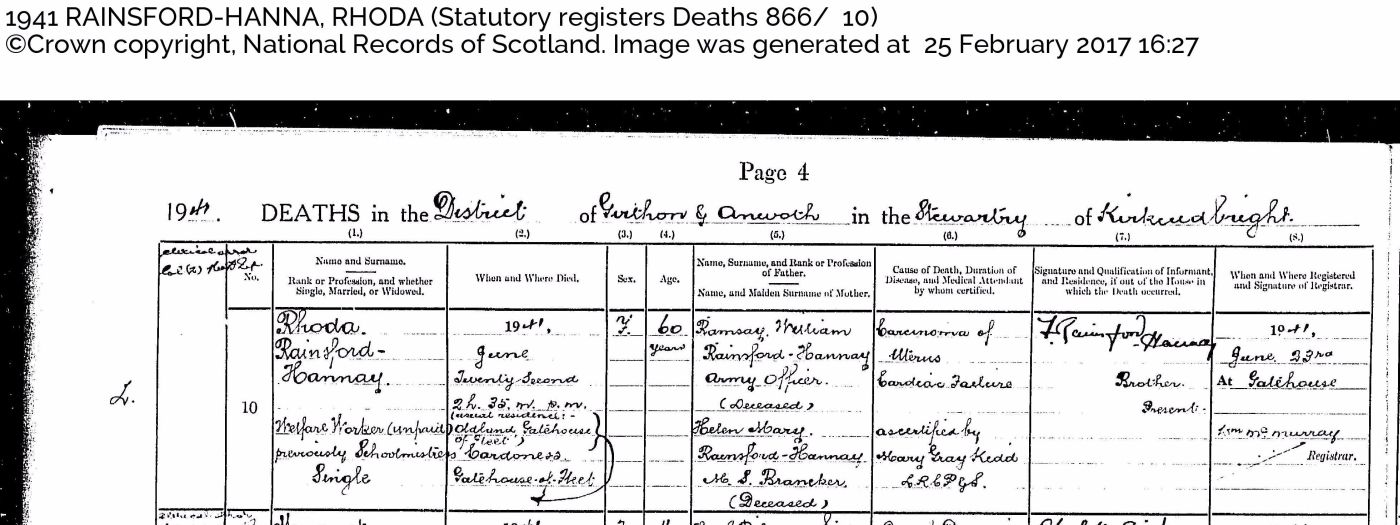
Rhoda Helen Rainsworth-Hannay death 1941
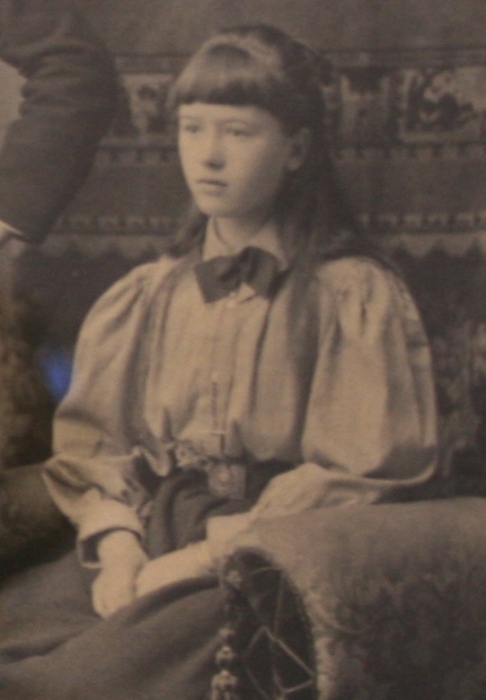
Rhoda Rainsford-Hannay
- 1881
- 188103 Apr 1881Rhoda was enumerated as the daughter of John Brancker on the 1881 Census of England residing at Greenbank House in Liverpool, Toxteth Park, Lancashire, EnglandG. She was 0 years old.
Also residing in the same household were Mary Reallo, Helen Jane Brancker, Mary Rainsford-Hannay, and Lieut Col. John Rainsford-Hannay.Citation: 2 - 1891105 Apr 1891Rhoda was enumerated as the daughter of Colonel Ramsay William Rainsford-Hannay, DL JP, on the 1891 Census of England in Portsmouth, Portsea, Hampshire, EnglandG. She was 10 years old.
Also residing in the same household were Helen Jane Brancker, Mary Rainsford-Hannay, Colonel Frederick Rainsford-Hannay, CMG DSO DL JP, Lieut Col. John Rainsford-Hannay, Lieut. Col. Archibald Gordon Rainsford-Hannay, Major Ramsay Rainsford-Hannay, and Lieut. Col. Donald Rainsford-Hannay.Citation: 3 - 19012031 Mar 1901Rhoda was enumerated as the daughter of Colonel Ramsay William Rainsford-Hannay, DL JP, on the 1901 Census of Ireland in Grange, Douglas, County Cork, IrelandG. She was 20 years old.
Also residing in the same household were Helen Jane Brancker, Mary Rainsford-Hannay, and Percival Rainsford-Hannay. - 1940~59
- 194160
- 194160
- 1941Probate27 Aug 1941She had her estate probated on 27 Aug 1941. The Probate entry reads:
RAINSFORD-HANNAY Rhoda of Oldland, Gatehouse of Fleet, Kirkcudbrightshire, spinster, died 22 June 1941. Confirmation of Archibald Gordon Rainsford-Hannay lieutenant-colonel H.M. army and Gavin Leith Allardyce writer to the signet. Sealed Llandudno, 27 August. - 1941~60Note1941She never married and had no children.
Citations
- [S19] General Registry Office of Scotland, online www.scotlandspeople.gov.uk, Statutory Birth Registrations. Hereinafter cited as General Registry Office.
- [S20] Ancestry.com, online www.ancestry.com, 1881 England Census. Hereinafter cited as Ancestry.com.
- [S20] Ancestry.com, online www.ancestry.com, 1891 England Census.
- [S19] General Registry Office, online www.scotlandspeople.gov.uk, Statutory Death Registrations.
- [S9] Alison Mitchell, compiler, The Stewartry of Kirkcudbright Monumental Inscriptions, Pre 1855 (Edinburgh, Scotland: Scottish Genealogy Society, 1995), Volume 6, Section 27b, Grave 1. Hereinafter cited as Kirkcudbright Monumental Inscriptions.
Lieut. Col. Archibald Gordon Rainsford-Hannay
#660, (1882 - 1971)
Parents
| Father | Colonel Ramsay William Rainsford-Hannay, DL JP (1844 - 1933) |
| Mother | Helen Jane Brancker (1847 - 1917) |
| Person included on these Charts: | Descendants of Odo A'Hannay of Sorbie |
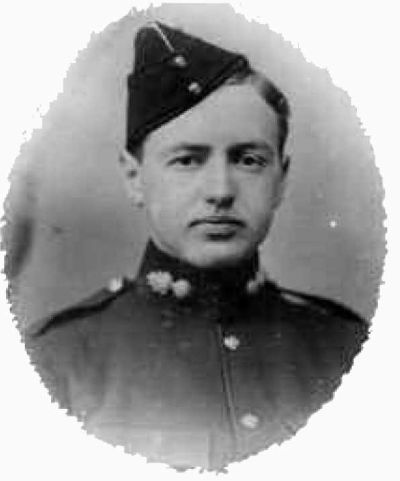
Archibald Gordon Rainsford-Hannay
- 1882
- 189185 Apr 1891Archibald was enumerated as the son of Colonel Ramsay William Rainsford-Hannay, DL JP, on the 1891 Census of England in Portsmouth, Portsea, Hampshire, EnglandG. He was 8 years old.
Also residing in the same household were Helen Jane Brancker, Mary Rainsford-Hannay, Colonel Frederick Rainsford-Hannay, CMG DSO DL JP, Lieut Col. John Rainsford-Hannay, Rhoda Helen Rainsford-Hannay, Major Ramsay Rainsford-Hannay, and Lieut. Col. Donald Rainsford-Hannay.Citation: 1 - 1901~19
- 1917~35Marriage | Muriel Erskine Austin1917He and Muriel Erskine Austin were married in 1917 in Luton, Bedfordshire, EnglandG.Citation: 4
- 197188
- 1971~89Note1971Biography
He was educated at Wellington College, Wellington, Berkshire, England and at Royal Military Academy, Woolwich, Kent, England.
He fought in the First World War in the Expedition to Darfur in 1916. He gained the rank of Lieutenant-Colonel in the service of the Royal Engineers.
He was decorated with the award of the Order of the Nile and the Companion, Distinguished Service Order (D.S.O.). He also was invested as a Officer, Order of the British Empire (O.B.E.).Citation: 6
Citations
- [S20] Ancestry.com, online www.ancestry.com, 1891 England Census. Hereinafter cited as Ancestry.com.
- [S20] Ancestry.com, online www.ancestry.com, England & Wales, Civil Registration Death Index, 1916-2007, Oxford District, Vol 6b, Page 3288.
- [S20] Ancestry.com, online www.ancestry.com, 1901 England Census.
- [S20] Ancestry.com, online www.ancestry.com, England & Wales, Civil Registration Marriage Index, 1916-2005, Luton District, Vol 3b, Page 945.
- [S24] FreeBMD website, online www.freebmd.org.uk, Oxford District, Vol 6b, Page 3288. Hereinafter cited as FreeBMD website.
- [S22] ThePeerage.com website compiled by Darryl Lundy, Wellington, New Zealand, online www.thepeerage.com. Hereinafter cited as ThePeerage website.
Major Ramsay Rainsford-Hannay
#661, (1884 - 1917)
Parents
| Father | Colonel Ramsay William Rainsford-Hannay, DL JP (1844 - 1933) |
| Mother | Helen Jane Brancker (1847 - 1917) |
| Person included on these Charts: | Descendants of Odo A'Hannay of Sorbie |
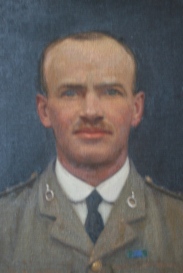
Ramsay Rainsford-Hannay, major
- 1884
- 189165 Apr 1891Ramsay was enumerated as the son of Colonel Ramsay William Rainsford-Hannay, DL JP, on the 1891 Census of England in Portsmouth, Portsea, Hampshire, EnglandG. He was 6 years old.
Also residing in the same household were Helen Jane Brancker, Mary Rainsford-Hannay, Colonel Frederick Rainsford-Hannay, CMG DSO DL JP, Lieut Col. John Rainsford-Hannay, Rhoda Helen Rainsford-Hannay, Lieut. Col. Archibald Gordon Rainsford-Hannay, and Lieut. Col. Donald Rainsford-Hannay.Citation: 1 - 1900~16
- 1901~17
- 1902~18
- 190319Military-Begin19 Aug 1903He began military service on 19 Aug 1903. 45th Rattray's Sikhs as a LieutenantCitation: 2
- 1908~24Military-NotesAbt 1908He fought in the North-West Frontier Campaign in Pakistan.
- 1911~27Occupation1911In 1911 Major Ramsay Rainsford-Hannay was a Lieutenant serving with the No. 34 Company, Sappers and Miners in India.Citation: 5
- 1914~30Military-NotesAbt 1914He fought in First World War where he was killed in action in 1917 in Mesopotamia (Iraq).Citation: 3
- 191732
- 191732
- 1917~33
Citations
- [S20] Ancestry.com, online www.ancestry.com, 1891 England Census. Hereinafter cited as Ancestry.com.
- [S20] Ancestry.com, online www.ancestry.com, Indian Army Quarterly List for 1 January 1912.
- [S22] ThePeerage.com website compiled by Darryl Lundy, Wellington, New Zealand, online www.thepeerage.com. Hereinafter cited as ThePeerage website.
- [S20] Ancestry.com, online www.ancestry.com, 1901 England Census.
- [S20] Ancestry.com, online www.ancestry.com, 1911 England Census.
- [S21] Find A Grave, online www.findagrave.com, Find A Grave Memorial# 13002477. Hereinafter cited as Find A Grave.
- [S9] Alison Mitchell, compiler, The Stewartry of Kirkcudbright Monumental Inscriptions, Pre 1855 (Edinburgh, Scotland: Scottish Genealogy Society, 1995), Volume 6, Section 27c, Entry 164. Hereinafter cited as Kirkcudbright Monumental Inscriptions.
Lieut. Col. Donald Rainsford-Hannay
#662, (1885 - 1946)
Parents
| Father | Colonel Ramsay William Rainsford-Hannay, DL JP (1844 - 1933) |
| Mother | Helen Jane Brancker (1847 - 1917) |
| Person included on these Charts: | Descendants of Odo A'Hannay of Sorbie |
- 1885
- 189155 Apr 1891Donald was enumerated as the son of Colonel Ramsay William Rainsford-Hannay, DL JP, on the 1891 Census of England in Portsmouth, Portsea, Hampshire, EnglandG. He was 5 years old.
Also residing in the same household were Helen Jane Brancker, Mary Rainsford-Hannay, Colonel Frederick Rainsford-Hannay, CMG DSO DL JP, Lieut Col. John Rainsford-Hannay, Rhoda Helen Rainsford-Hannay, Lieut. Col. Archibald Gordon Rainsford-Hannay, and Major Ramsay Rainsford-Hannay.Citation: 2 - 1901~16
- 191428Military-Begin4 Aug 1914He began military service on 4 Aug 1914. 53rd Sikhs Frontier Force
- 1920~35Marriage | Gladys Emily M. Woodcock1920He and Gladys Emily M. Woodcock were married in 1920 at Kensington in London, EnglandG.
- 193751Passenger List18 Sep 1937He was found on a passenger list on 18 Sep 1937. Donald sailed on the "Brittannia" which departed from Liverpool for Bombay, India. Home address is 28 The Drive, Ashford Common, Middlesex.Citation: 4
- 194660
- 194660
- 1947Probate4 Oct 1947He had his estate probated on 4 Oct 1947. The Probate entry reads:
RAINSFORD-HANNAY Donald of Sind Club, Karachi India died 27 Mar 1946 at the I.B.G. Hospital, Karachi. Probate London 4 October to Galdys Marion Rainsford-Hannay widow. Effects £5118 7s. 5d. in England - 1947Note1947Biography
Educated at Wellington College and the Berkshire & Royal Military College, Sandhurst
Was a Major with 53rd Sikhs (Indian Army) and fought in the Mohmand and Afridi campaigns in 1908
He fought in the First World War, and was wounded at Loos
He was made an Officer, Order of the British Empire (O.B.E.) in 1918.
Served from 1932 to 1947 in the service of the Maharajas of Jind and Jodhpur.Citation: 6
Citations
- [S20] Ancestry.com, online www.ancestry.com, UK, British Army Lists, 1882-1962. Hereinafter cited as Ancestry.com.
- [S20] Ancestry.com, online www.ancestry.com, 1891 England Census.
- [S20] Ancestry.com, online www.ancestry.com, 1901 England Census.
- [S20] Ancestry.com, online www.ancestry.com, UK, Outward Passenger Lists, 1890-1960.
- [S23] The Gatehouse Folk.com website, online http://www.gatehouse-folk.org.uk. Hereinafter cited as The Gatehouse Folk website.
- [S22] ThePeerage.com website compiled by Darryl Lundy, Wellington, New Zealand, online www.thepeerage.com. Hereinafter cited as ThePeerage website.
Dorothea Letitia Maxwell
#663, (1888 - 1981)
Parents
Family: Colonel Frederick Rainsford-Hannay, CMG DSO DL JP (1878 - 1959)
| Son | Ramsay William Rainsford-Hannay, 15th of Kirkdale+ (1911 - 2004) |
| Son | Gavin Rainsford-Hannay (1914 - 1914) |
- 1888
- 19102216 Aug 1910Colonel Frederick Rainsford-Hannay, CMG DSO DL JP, and she were married on 16 Aug 1910 at Anwoth Church in Anwoth Parish, Kirkcudbrightshire, ScotlandG.Citation: 2
- 19384918 Mar 1938She was found on a passenger list with Colonel Frederick Rainsford-Hannay, CMG DSO DL JP, on 18 Mar 1938 in Southampton, EnglandG.
- 1954653 Mar 1954She was found on a passenger list with Colonel Frederick Rainsford-Hannay, CMG DSO DL JP, on 3 Mar 1954 in Southampton, EnglandG.Citation: 3
- 198193
- 198193
Citations
- [S9] Alison Mitchell, compiler, The Stewartry of Kirkcudbright Monumental Inscriptions, Pre 1855 (Edinburgh, Scotland: Scottish Genealogy Society, 1995), Volume 6, Section 27b, Grave 8. Hereinafter cited as Kirkcudbright Monumental Inscriptions.
- [S19] General Registry Office of Scotland, online www.scotlandspeople.gov.uk, Statutory Marriage Registrations. Hereinafter cited as General Registry Office.
- [S20] Ancestry.com, online www.ancestry.com, UK, Outward Passenger Lists, 1890-1960. Hereinafter cited as Ancestry.com.
Ramsay William Rainsford-Hannay, 15th of Kirkdale
#664, (1911 - 2004)
Parents
| Father | Colonel Frederick Rainsford-Hannay, CMG DSO DL JP (1878 - 1959) |
| Mother | Dorothea Letitia Maxwell (1888 - 1981) |
Family: Margaret Wiseman ( - 1994)
| Daughter | Jessica Margaret Rainsford-Hannay (1937 - ) |
| Son | Dr. David W. Rainsford Hannay+ (1939 - ) |
| Person included on these Charts: | Descendants of Odo A'Hannay of Sorbie |
- NoteObituary of Ramsay William Rainsford Hannay
The Scotsman Online
Published 16 March 2004
RAMSAY Hannay, a war-time member of the Special Operations Executive who was in Paris for the liberation of France and reached Berlin before the advancing Russian armies, has died at the age of 92.
He was head of one of the oldest established families in south-west Scotland. They originated from Sorbie Tower in Wigtownshire and have lived at their present home at Kirkdale, near Newton Stewart, since 1532. A founder member of the Clan Hannay Society in 1960, he was subsequently asked to become its chief. This he agreed to do, with misgivings and some amusement, but he came to enjoy the contact it gave him with people across the world and he made several trips to clan events in the United States. He proved to be a popular and committed chief of the clan and gave a warm welcome to any member venturing to Galloway in search of their roots. He was a member of the Council of Chiefs and of the Royal Company of Archers.
Ramsay William Rainsford Hannay was born in 1911 in India, where his father was serving in the army. He was one of two brothers who, like many in India at that time, caught dysentery. Only he survived; his brother died in infancy. He returned to Scotland with his parents and, while his father was in the trenches in France, he lived with his mother in Edinburgh, where he first went to school. He had early memories of barefoot children in the poverty of the Old Town and of black plumed horses leading funeral processions along Princes Street for victims of the 1918 ’flu pandemic, which claimed more victims worldwide than there were casualties in the First World War.
It was a war in which his father was wounded, and his mother lost her only brother, killed at Gallipoli while serving with the King’s Own Scottish Borderers. He also lost another uncle, on his father’s side, who died in Mesopotamia, which is now Iraq.
Ramsay was educated at Winchester College and Trinity College, Cambridge, where he studied law and where he rowed for his college, as he had for his school. After university, he worked for an estate agent in Ayrshire before going to London to complete his legal training.
At the outbreak of the Second World War, he joined the Highland Light Infantry but, after being stationed in Glasgow, he was seconded to the Special Operations Executive, where he trained personnel in both the UK and Canada for operations behind enemy lines in Europe. However, he spoke little about his time with the SOE.
After the war, he resumed his career in the legal department of the Board of Trade in London, where he worked under prime ministers Harold Wilson and Edward Heath.
As a younger man, he was a keen sailor and was a member of the Royal Ocean Racing Club. When he was in his mid-50s, he inherited two old family properties close to each other in Galloway, including two large houses. With great foresight, he demolished two-thirds of one and converted the other into apartments. He used the potential of beaches on the Solway coast to start a successful caravan park, which provided a way for his family to continue their long association with the area.
He continued his father’s involvement with the Scouts and with dry stane walling. For more than 25 years, he was the president of the Galloway Area Scout Council, and for many years served on the committee of the dry stane dyking competition. He was a founder member of the Dry Stone Walling Association of Great Britain, and at one time its president. A founder chairman of the South West of Scotland Holiday Parks Association, he was also on the National Caravan Council and the National Federation of Site Operators. He was a Trustee of Carsluith Hall and honorary president of the Gatehouse Festival Group.
To all these many activities, he brought humour, broad experience, his Christian faith and a genuine concern for the people involved and what they were trying to achieve.
In 1936, he married Margaret Wiseman, who predeceased him, and he is survived by a daughter and a son, three grandsons, and four great grandchildren. He had been living in a cottage next to his grandson and great grandchildren, but latterly was in a local nursing home, where he faced his increasing disabilities with patience, courage and good humour. - 1911Birth15 Jun 1911Ramsay William Rainsford-Hannay, 15th of Kirkdale, was born on 15 Jun 1911 in Conoor, IndiaG.
- 1936~25Marriage | Margaret Wiseman1936Death: on 14 Nov 1994He and Margaret Wiseman were married in 1936 in Chelsea District, Greater London, EnglandG.Citation: 1
- 200492Death10 Jan 2004He died on 10 Jan 2004 at age 92 in Gatehouse of Fleet, Kirkcudbrightshire, ScotlandG.
- 200492
- 200492NoteJan 2004Ramsay William Rainsford Hannay was educated at Winchester College, Winchester, Hampshire, England. He graduated from Trinity College, Cambridge University, Cambridge, Cambridgeshire, England, in 1932 with a Bachelor of Arts (B.A.).
He was admitted to Inner Temple in 1933 entitled to practice as a barrister. He was with the Solicitors' Department, Board of Trade between 1939 and 1964. He was commissioned in 1940 with the rank of officer, in the service of the Highland Light Infantry. He fought in the Second World War.
He retired from the military in 1946, with the rank of Major, late of the Highland Light Infantry. He held the office of Hon. Sheriff Substitute of the Stewartry of Kirkcudbright. He was admitted to Royal Company of Archers in 1949. He held the position of Chief of the Name and Arms of Hannay in 1959.
In 1980 his name was legally changed to Ramsford William Rainsford Hannay. He was recognised by the Lord Lyon King of Arms as Representer of the feudal Baronial House of Maxwell of Cardoness and 15th of Kirkdale, and matriculated his arms at the Lyons Office Representer of the feudal Baronial House of Maxwell of Cardoness and 15th of Kirkdale on 31 October 1983. In 2003 he lived at Cardoness, Gatehouse-of-Fleet, Kirkcudbrightshire, Scotland.Citation: 2 - 2004Note30 Jan 2004Obituary of Ramsay William Rainsford Hannay
Galloway Gazette newspaper, January 30, 2004
Ramsay W. Rainsford Hannay was born in India where his father was serving in the army, but returned as a child to Edinburgh during the First World War. He was subsequently educated at Winchester college where he rowed for his school, as he did for Trinity College, Cambridge, where he read law.
At the outbreak of the Second World War he joined the Highland Light Infantry but was seconded to Special Operations where he trained personnel in Canada and the UK for action behind enemy lines in Europe. He was in Paris for the liberation of France, and in Berlin before the Russian Army arrived.
After the war he worked in the legal department of the Board of Trade under Harold Wilson and Edward Heath, before taking early retirement to manage the family estate in Galloway, where he established a successful caravan holiday park.
Ramsay Hannay was a founder member of the Clan Hannay Society in 1960 and subsequently became its first Chief. The Hannay, Hannnah, Hanna and Hanneys originated from Sobie in Wigtownshire. Sorbie Tower was donated to the Clan Hannay Society in 1965, since when there have been annual Clan Gatherings and growing international membership. Ramsay Hannay was a member of the Council of Chiefs and travelled widely to Clan functions, especially in North America. He took a great interest in Clan Members who were always made welcome when they visited Galloway.
A man of integrity with a strong sense of humour, and a natural concern for others, his avice was widely sought. He was an Honory Sheriff and continued his own father's involvement with scouting, being President of the Galloway Area Scout Council, and with Dry Stone Walling, being a founder member of the Dry Stone Walling Association of Great Britain and at one time its President. He was also a founding Chairman of the south West Holiday Parks Association, President of the Gatehouse Festival Group, and Trustee of Carsluith Village Hall.
In 1936 he married Margaret Wiseman, who predeceased him, and is survived by a daughter and son, three grandchildren and four great-grandchildren. After a well attended Service of Thanksgiving at Kirkmabreck Parish Church, Creetown, he was buried in the old churchyard above Kirkdale house, his family home.
Citations
John Brancker
#665, (Abt 1819 - )
Family: Mary Reallo (Abt 1822 - )
| Daughter | Helen Jane Brancker+ (1847 - 1917) |
- 1819
- 1845~26
- 1881~62
- 1881~62CensusENG3 Apr 1881John was enumerated on the 1881 Census of England residing at Greenbank House in Liverpool, Toxteth Park, Lancashire, EnglandG. He was ~62 years old.
Also residing in the same household were Mary Reallo, Helen Jane Brancker, Mary Rainsford-Hannay, Lieut Col. John Rainsford-Hannay, and Rhoda Helen Rainsford-Hannay. The household included ten servants.Citation: 1
Citations
- [S20] Ancestry.com, online www.ancestry.com, 1881 England Census. Hereinafter cited as Ancestry.com.
Reverend Sir James Cameron Lees
#666, (1834 - 1913)
Family: Rhoda Clara Rainsford-Hannay (1843 - 1887)
| Daughter | Constance Lees (1874 - ) |
| Daughter | Mabel Lees (1876 - 1894) |
| Son | John Lees (1879 - ) |
| Son | John Cameron Lees (1879 - 1909) |
- 1834
- 18362
- 187237Marriage | Rhoda Clara Rainsford-Hannay7 Feb 1872He and Rhoda Clara Rainsford-Hannay were married on 7 Feb 1872 at Kirkdale HouseG, in Kirkmabreck Parish, Kirkcudbrightshire, ScotlandG.Citation: 3
- 1881~47
- 188146CensusSCO3 Apr 1881James was enumerated on the 1881 Census of Scotland residing at 33 Blacket Place in Edinburgh, Midlothian, ScotlandG. He was 46 years old.
Also residing in the same household were Rhoda Clara Rainsford-Hannay, Constance Lees, Mabel Lees, and John Lees.Citation: 1 - 191378
- 191378
- 1913
Citations
- [S19] General Registry Office of Scotland, online www.scotlandspeople.gov.uk, 1881 Scotland Census. Hereinafter cited as General Registry Office.
- [S20] Ancestry.com, online www.ancestry.com, England & Wales, Non-Conformist and Non-Parochial Registers, 1567-1970. Hereinafter cited as Ancestry.com.
- [S19] General Registry Office, online www.scotlandspeople.gov.uk, Statutory Marriage Registrations.
- [S20] Ancestry.com, online www.ancestry.com, England & Wales, National Probate Calendar (Index of Wills and Administrations), 1858-1966, 1973-1995.
- [S21] Find A Grave, online www.findagrave.com, Find A Grave Memorial# 151291598. Hereinafter cited as Find A Grave.
Constance Lees
#667, (1874 - )
Parents
| Father | Reverend Sir James Cameron Lees (1834 - 1913) |
| Mother | Rhoda Clara Rainsford-Hannay (1843 - 1887) |
| Person included on these Charts: | Descendants of Odo A'Hannay of Sorbie |
- 1874
- 1881~73 Apr 1881Constance was enumerated as the daughter of Reverend Sir James Cameron Lees on the 1881 Census of Scotland residing at 33 Blacket Place in Edinburgh, Midlothian, ScotlandG. She was ~7 years old.
Also residing in the same household were Rhoda Clara Rainsford-Hannay, Mabel Lees, and John Lees.Citation: 1 - 1900~26Marriage | Reverend Thomas Edward TaylorAbt 1900Reverend Thomas Edward Taylor and she were married abt 1900.
Citations
- [S19] General Registry Office of Scotland, online www.scotlandspeople.gov.uk, 1881 Scotland Census. Hereinafter cited as General Registry Office.
Mabel Lees
#668, (1876 - 1894)
Parents
| Father | Reverend Sir James Cameron Lees (1834 - 1913) |
| Mother | Rhoda Clara Rainsford-Hannay (1843 - 1887) |
| Person included on these Charts: | Descendants of Odo A'Hannay of Sorbie |
- 1876
- 1881~53 Apr 1881Mabel was enumerated as the daughter of Reverend Sir James Cameron Lees on the 1881 Census of Scotland residing at 33 Blacket Place in Edinburgh, Midlothian, ScotlandG. She was ~5 years old.
Also residing in the same household were Rhoda Clara Rainsford-Hannay, Constance Lees, and John Lees.Citation: 1 - 1894~18
Citations
John Lees
#669, (1879 - )
Parents
| Father | Reverend Sir James Cameron Lees (1834 - 1913) |
| Mother | Rhoda Clara Rainsford-Hannay (1843 - 1887) |
| Person included on these Charts: | Descendants of Odo A'Hannay of Sorbie |
- 1879
- 1881~23 Apr 1881John was enumerated as the son of Reverend Sir James Cameron Lees on the 1881 Census of Scotland residing at 33 Blacket Place in Edinburgh, Midlothian, ScotlandG. He was ~2 years old.
Also residing in the same household were Rhoda Clara Rainsford-Hannay, Constance Lees, and Mabel Lees.Citation: 1
Citations
- [S19] General Registry Office of Scotland, online www.scotlandspeople.gov.uk, 1881 Scotland Census. Hereinafter cited as General Registry Office.
Reverend Thomas Edward Taylor
#670
- 1900Marriage | Constance LeesAbt 1900Reverend Thomas Edward Taylor and Constance Lees were married abt 1900.
John Cameron Lees
#671, (1879 - 1909)
Parents
| Father | Reverend Sir James Cameron Lees (1834 - 1913) |
| Mother | Rhoda Clara Rainsford-Hannay (1843 - 1887) |
| Person included on these Charts: | Descendants of Odo A'Hannay of Sorbie |
- 1879Birth1879John Cameron Lees was born in 1879.
- 1909~30Death1909He died in 1909 at age ~30.
- 1909~30
Citations
- [S21] Find A Grave, online www.findagrave.com, Find A Grave Memorial# 151291714. Hereinafter cited as Find A Grave.
Evelyn Gordon Forbes
#672, (1880 - 1950)
Parents
| Father | Stevenson Forbes (1823 - 1889) |
| Mother | John Anne (Johanna) Gordon (Abt 1843 - 1884) |
Family: Lieut Col. John Rainsford-Hannay (1879 - 1951)
| Daughter | Marjorie Gordon Rainsford-Hannay (1907 - ) |
| Son | Patrick Ramsay Rainsford-Hannay+ (1911 - 1968) |
| Son | Denis Lewis Errington Rainsford-Hannay (1914 - 1928) |
- 1880
- 1881~13 Apr 1881Evelyn was enumerated as the daughter of Stevenson Forbes on the 1881 Census of England residing at 68 West Hill High Clere in Sydenham, Kent, EnglandG. She was ~1 years old.
Also residing in the same household were John Anne (Johanna) Gordon.Citation: 1 - 1901~2131 Mar 1901Evelyn was enumerated as the boarder of Sir William Gordon, of Earlston and Afton, 6th Baronet, on the 1901 Census of England residing at Beach Mansion Hotel in Portsmouth, Southampton, EnglandG. She was ~21 years old.
Also residing in the same household were Lady Mary Grace Maxwell.Citation: 2 - 1904~24Marriage | Lieut Col. John Rainsford-Hannay8 Jan 1904Lieut Col. John Rainsford-Hannay and she were married on 8 Jan 1904 at Saint Giles Church in Edinburgh, Midlothian, ScotlandG.Citation: 3
- 1950~70
- 1951
Citations
- [S20] Ancestry.com, online www.ancestry.com, 1881 England Census. Hereinafter cited as Ancestry.com.
- [S20] Ancestry.com, online www.ancestry.com, 1901 England Census.
- [S19] General Registry Office of Scotland, online www.scotlandspeople.gov.uk, Statutory Marriage Registrations. Hereinafter cited as General Registry Office.
- [S9] Alison Mitchell, compiler, The Stewartry of Kirkcudbright Monumental Inscriptions, Pre 1855 (Edinburgh, Scotland: Scottish Genealogy Society, 1995), Volume 6, Section 27b, Grave 4. Hereinafter cited as Kirkcudbright Monumental Inscriptions.
- [S19] General Registry Office, online www.scotlandspeople.gov.uk, Statutory Death Registrations.
Edward Adam Cliff-McCullough
#674, (1853 - 1915)
- 1853
- 1881~28
- 1881~28Occupation1881In 1881 Edward Adam Cliff-McCullough was a merchant and ship owner in Claremont, West Derby District, Lancashire, EnglandG.
- 1913~60
- 1913~60Marriage | Mary Rainsford-Hannay20 May 1913He and Mary Rainsford-Hannay were married on 20 May 1913 at Troqueer Church in Maxwelltown, Troqueer Parish, Kirkcudbrightshire, ScotlandG.
- 1915~62
- 1915Probate3 Dec 1915He had his estate probated on 3 Dec 1915. The Probate entry reads:
CLIFF-McCULLOUGH, Edward Adam of Netherwood Bank, Dumfries, died 30 August 1915 at Carlisle Administration, London, 3 December to Mary Rainsford Cliff-McCullough widow. Effects £5680 14s. 3d.Citation: 3
Citations
- [S20] Ancestry.com, online www.ancestry.com, 1881 England Census. Hereinafter cited as Ancestry.com.
- [S19] General Registry Office of Scotland, online www.scotlandspeople.gov.uk, Statutory Marriage Registrations. Hereinafter cited as General Registry Office.
- [S20] Ancestry.com, online www.ancestry.com, England & Wales, National Probate Calendar (Index of Wills and Administrations), 1858-1966, 1973-1995.
Mary Reallo
#675, (Abt 1822 - )
Family: John Brancker (Abt 1819 - )
| Daughter | Helen Jane Brancker+ (1847 - 1917) |
- 1822
- 1845~23
- 1881~593 Apr 1881Mary was enumerated as the wife of John Brancker on the 1881 Census of England residing at Greenbank House in Liverpool, Toxteth Park, Lancashire, EnglandG. She was ~59 years old.
Also residing in the same household were Helen Jane Brancker, Mary Rainsford-Hannay, Lieut Col. John Rainsford-Hannay, and Rhoda Helen Rainsford-Hannay.Citation: 1
Citations
- [S20] Ancestry.com, online www.ancestry.com, 1881 England Census. Hereinafter cited as Ancestry.com.