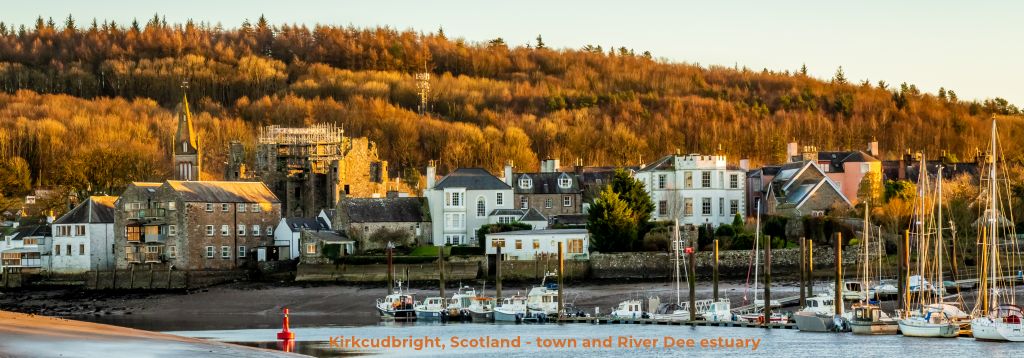
Researching Gordons in Kirkcudbrightshire
A family history article by Sandy Gordon — compiled for kkb.gordons.site
Kirkcudbrightshire — also known as the Stewartry of Kirkcudbright — is one of Scotland's more rewarding counties for genealogical research. Its parish records are reasonably well preserved, its population was relatively stable for centuries, and the digitization work done by the National Records of Scotland (NRS) through ScotlandsPeople makes much of the county accessible from home before you ever consider a research trip.
This guide reflects hands-on research conducted in the 1990s, combined with the considerable online resources now available. The goal is to give you a practical starting point for tracing Gordon and other Kirkcudbrightshire families through the full range of Scottish records.
The Record Types You'll Use Most
All four major record types proved useful for Kirkcudbrightshire research — and in practice you'll use them in combination, not in isolation.
Old Parochial Registers (OPRs) are the backbone of Scottish genealogy before 1855. These are the registers kept by Church of Scotland (Kirk) parishes recording baptisms, proclamations of marriage banns, and burials. For Kirkcudbrightshire, OPR coverage varies by parish — some go back to the 1600s, others are patchy or start later.
Baptism entries typically record the child's name, father's name, mother's maiden name, and date — but rarely the child's birth date (the baptism date is recorded instead). Marriage entries often record the proclamation date rather than the wedding date itself. Burial records are the least consistently kept and sometimes absent entirely. Gordon is spelled many ways in older records: Gordone, Gordan, Gourdon. Use wildcard searches on ScotlandsPeople (e.g., Gord*) to catch variants, and search by parish rather than countywide when you have a location — it reduces noise considerably.
Statutory Registers (post-1855) begin on 1 January 1855, when civil registration became compulsory in Scotland. These records — births, marriages, and deaths — are far more detailed than OPRs. Birth records include both parents' names, ages, birthplaces, and the date and place of marriage. Marriage records include the parents of both parties. Death records include the name of the informant (often a family member) and the deceased's parents. The 1855 registers are the most detailed of all — the NRS scaled back the required information in 1856 after complaints about the workload, so that single year is exceptionally rich.
Census Records from 1841 through 1921 are available on ScotlandsPeople and are essential for placing families in specific households, identifying siblings, and bridging generations. The 1841 census does not record exact ages for adults and does not record birthplaces beyond the county level. From 1851 onward, birthplaces are specific — invaluable for tracing migration out of the county.
The most effective approach is to work backward from what you know: start with statutory records to establish parents and grandparents, use census records to place the family geographically, move into OPRs for generations before 1855, and use census birthplace data to identify which parish to search.
Kirkcudbrightshire Parishes
The county contains around 30 historic parishes. For Gordon family research, the most productive parishes have been spread across the county. Key parishes to know:
- Anwoth and Girthon — western parishes near Gatehouse of Fleet
- Kirkmabreck — coastal parish on the Solway shore, near Creetown
- Kirkpatrick Durham — a smaller rural parish with reasonably complete OPRs
- Crossmichael — sits on the Water of Ken, good OPR coverage
- Parton — small parish, useful for families near Loch Ken
- Kells — covers the upland area around New Galloway
- Balmaclellan — another upland parish worth checking for Gordon families
- Tongland and Twynholm — southern parishes near Kirkcudbright town
When a family disappears from one parish's records, check neighboring parishes — families moved short distances, and parish boundaries are not always obvious from modern maps.
The Neighboring County: Wigtownshire
Wigtownshire — the peninsula to the west of Kirkcudbrightshire — is a natural extension of any Kirkcudbrightshire research. Families moved across the county boundary regularly, and a Gordon family that disappears from Kirkcudbrightshire records may simply have moved west into Wigtownshire parishes such as Minnigaff, Penninghame, or Kirkcowan.
ScotlandsPeople covers Wigtownshire records with the same tools and search interface. When a Kirkcudbrightshire search stalls, broadening to the neighboring county is a logical next step before assuming a record gap.
Walking the Kirkyards
One of the most valuable — and most overlooked — research activities in Kirkcudbrightshire is walking the kirkyards and recording grave monuments in person. Inscriptions on headstones often include information not found in any register: a spouse's name, the names of children who predeceased the parents, a former place of residence, or an occupation.
Bring a camera and a notebook. Photograph every stone that may be relevant, even if you are unsure of the connection at the time — it costs nothing and the stone may be less legible on a future visit. Write down your own notes alongside the photographs: the parish, the section of the yard, and the condition of the stone. Lichen, weathering, and moss can make a stone unreadable within a generation.
The value of this work compounds over time. Notes and photographs taken in the 1990s can resolve questions that arise years or decades later, long after the stones themselves have deteriorated further. A systematic pass through the kirkyard of every parish you are researching is time well spent.
Using ScotlandsPeople
ScotlandsPeople (scotlandspeople.gov.uk) is the official Scottish government genealogy portal and the primary online source for all the record types above. It operates on a credit system — you purchase credits and spend them to view record images.
A few practical tips: index results (names, dates, parishes) are free to browse, so search before you spend credits. Use the asterisk wildcard — Gord* catches Gordon, Gordone, Gordan, and other variants in a single search. Narrow results to Kirkcudbright county to reduce false matches for common surnames. Once you've purchased a record view, download the image immediately — credits are non-refundable. And always view the original image when an index entry looks close but not exact, as transcription errors in older records are common.
Managing What You Find
Kirkcudbrightshire Gordon research can quickly generate a large number of families that appear unrelated to one another. A few practices help keep the work manageable.
Document negative findings. Recording that a particular family does not connect to your line is as useful as a positive match — it prevents re-researching the same dead end later. Use a consistent naming convention for unconfirmed families (e.g., “Gordon Family A — Crossmichael”) until a connection is established or ruled out. Note record gaps: if a parish's OPRs are missing for a particular decade, record that fact — it explains why a generation seems to vanish.
Further Resources
- ScotlandsPeople — the primary portal for OPRs, statutory records, and census
- FamilySearch — free index and some images for Scottish records; useful for a first pass before committing credits on ScotlandsPeople
- Kirkcudbright.co — historical index of people and places of the Stewartry, with GPS coordinates for place names and searchable historical extracts
- Kirkyards.co.uk — monument inscriptions for parish cemeteries in Kirkcudbrightshire
- Gatehouse Folk — historical photographs and local history centered on Gatehouse of Fleet and the parishes of Girthon and Anwoth
- Canmore — Historic Environment Scotland's database, useful for locating historic farmsteads and settlements that no longer appear on modern maps
- Dumfries and Galloway Family History Society — covers all three counties of southwest Scotland
— Sandy Gordon, Sequim, Washington, USA